


9.7.4 leash codehs answers – If you are working through the CodeHS curriculum, you may have come across the assignment titled “9.7.4 Leash.” This particular exercise is part of the JavaScript graphics lessons, and it is one of the most commonly searched problems online, often with the query “9.7.4 leash CodeHS answers.”
Many students search for ready-made answers because they encounter difficulties understanding the exercise. However, this assignment is not just about getting the right output—it is designed to teach important programming concepts, including mouse event handling, graphics manipulation, and interactive animations. This article will help you understand the assignment, explain its concepts in detail, discuss common mistakes, and provide strategies for solving it successfully.
What Is the 9.7.4 Leash Assignment?
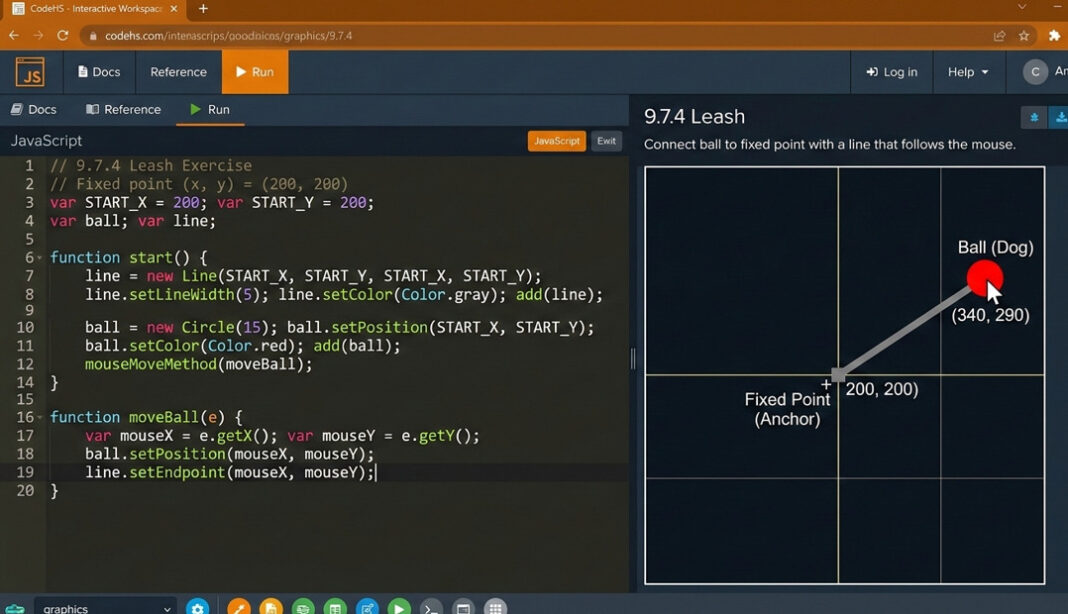
The 9.7.4 Leash exercise is part of the JavaScript graphics section in CodeHS. The objective is to create a program where a ball is connected to a fixed point with a line, often referred to as a “leash,” and moves in response to the user’s mouse movements.
Imagine a dog on a leash. The leash connects the dog to a fixed point, and as the dog moves, the leash stretches and follows. Similarly, in this exercise, the ball follows the mouse while remaining connected by the leash. This introduces students to concepts such as dynamic updates, coordinate systems, and interactive programming.
Although the exercise is presented as a small project, it forms the foundation for more complex programming tasks in the future, especially those involving interactive graphics and event-driven logic.
Key Concepts in the 9.7.4 Leash Assignment
The exercise is designed to teach several important programming concepts, including:
Mouse Event Handling
One of the core ideas is detecting mouse movement and responding dynamically. The program must be able to track the position of the mouse and update the ball’s location on the screen accordingly. This introduces students to event-driven programming, where certain functions are executed in response to user actions.
Graphics and Shapes
The exercise uses graphical elements to represent objects on the screen. The ball is typically represented as a circle, while the leash is represented as a line connecting two points. Understanding how to position these shapes on a canvas is an essential skill for interactive graphics programming.
Coordinate Systems
A canvas in programming uses a coordinate system where the top-left corner is the origin point (0,0). The horizontal axis (X) increases to the right, and the vertical axis (Y) increases downward. Knowing how to work with coordinates allows students to control the placement of objects and manage dynamic updates accurately.
Dynamic Updates and Animation
Another concept in this assignment is dynamically updating objects. The ball and leash must update continuously as the mouse moves to create smooth animation. This teaches students about real-time programming logic and maintaining a program’s state while interacting with user input.
Common Mistakes Students Make
Many students search for 9.7.4 leash CodeHS answers because they encounter difficulties with specific aspects of the assignment. Some common mistakes include:
- Failing to Update the Leash: Students may move the ball correctly but forget to adjust the endpoint of the leash. As a result, the ball moves but the leash remains static.
- Incorrect Event Handling: Using the wrong type of mouse event can cause the program not to respond as intended. Beginners often confuse click events with mouse movement events.
- Forgetting to Add Objects to the Canvas: If objects like the ball or line are not properly added to the canvas, they will not appear, which can confuse students when testing their programs.
- Creating New Objects Repeatedly: Some students accidentally create a new ball or line each time the mouse moves, which can slow down the program and create unexpected results. The correct approach is to update the existing objects.
- Misunderstanding the Coordinate System: Positioning shapes incorrectly due to misunderstanding how coordinates work on the canvas is another common challenge.
Why Students Search for Answers?
There are several reasons students search for CodeHS answers instead of attempting the assignment independently:
- Difficulty Understanding Programming Concepts: For beginners, concepts like event handling and dynamic graphics can be overwhelming.
- Time Constraints: Students with tight deadlines may look for solutions online.
- Debugging Frustration: Small errors in code can prevent the program from running, prompting students to search for ready-made answers.
- Curiosity About Alternative Approaches: Some students want to see different ways to implement the assignment.
While searching for answers is common, it is always more beneficial to understand the logic behind the solution. This knowledge will help in future exercises and projects.
Tips for Successfully Completing the Assignment
Instead of simply copying answers, students can follow strategies to solve the problem effectively:
Break the Problem Into Steps
Divide the task into smaller parts. For example:
- Draw a static ball on the canvas.
- Draw a static line representing the leash.
- Set up mouse movement detection.
- Update the ball and leash positions based on mouse movement.
Breaking the problem into steps makes it more manageable and helps avoid errors.
Debug Incrementally
Test your program after completing each step to identify any mistakes early. This approach prevents frustration and allows you to understand which part of the code may be causing issues.
Practice Similar Exercises
CodeHS provides other interactive graphics exercises. Practicing these helps reinforce the concepts of mouse events, coordinate systems, and dynamic updates, making future assignments easier to tackle.
Understand Before Implementing
Focus on understanding how mouse movement affects objects on the canvas, why coordinates are important, and how to update shapes dynamically. Once you understand these principles, implementing the assignment becomes much simpler.
Why This Assignment Matters?
The 9.7.4 Leash assignment may seem simple, but it is valuable for several reasons:
- It introduces interactive programming concepts used in modern web and game development.
- It strengthens problem-solving skills by encouraging logical thinking and step-by-step implementation.
- It helps students understand how programs can respond to real-time user input, which is a critical skill in software development.
- It provides a foundation for more complex assignments in the CodeHS curriculum and other programming courses.
By mastering this exercise, students gain confidence in both JavaScript programming and interactive graphics.
How to Approach the Assignment Responsibly?
While online resources can be helpful, students should aim to:
- Understand the problem fully before looking at answers.
- Use external solutions only for guidance or clarification.
- Apply learned concepts to other exercises instead of copying solutions.
- Experiment with variations, such as different shapes, leash lengths, or movement constraints.
These practices encourage deeper learning and improve coding skills over time.
Final Thoughts
The 9.7.4 Leash assignment on CodeHS is designed to teach essential programming skills in an interactive and engaging way. Searching for 9.7.4 leash CodeHS answers is common, but students gain the most by understanding the logic behind the exercise. By focusing on mouse events, graphics, and dynamic updates, students can complete the assignment successfully and build a strong foundation for future programming projects.
Approaching the problem systematically, debugging carefully, and practicing similar exercises will ensure success not only with this assignment but also with more advanced programming challenges.
FAQs About 9.7.4 leash codehs answers
1. What is the 9.7.4 Leash exercise in CodeHS?
It is a programming assignment where a ball is connected to a line that follows the mouse on the screen.
2. Which programming concepts does it teach?
It teaches mouse event handling, interactive graphics, dynamic object updates, and working with coordinate systems.
3. Can students use pre-written answers?
While answers are available online, understanding the concepts is essential for learning and future exercises.
4. Why does the ball sometimes not move?
This usually occurs when the mouse event handling is not correctly implemented or the objects are not properly added to the canvas.
5. How does this exercise help in future programming?
It introduces interactive programming principles used in web development, games, and graphical applications.